
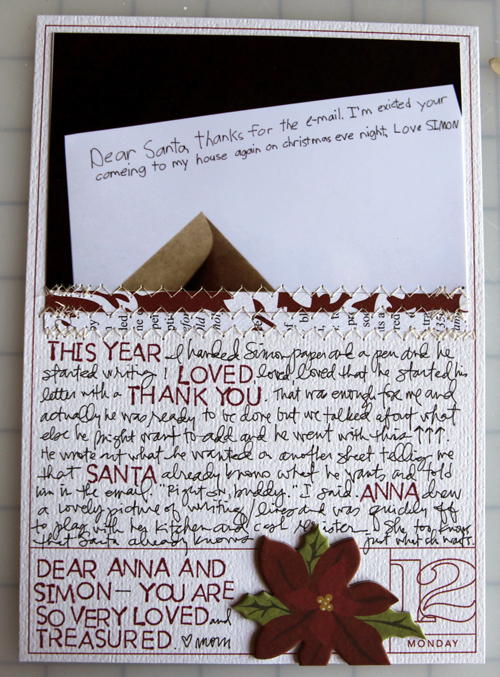
For today's post I wanted to ask Ali 5 questions about journaling. But when I sat down to write them out I couldn't put them into words. I just wanted her to talk to me. Then I remembered that I'd read a lot of what I wanted to hear before on this post about storytelling. So today isn't quite a guest post as it is taking words (below in red) and a picture from Ali's blog, with permission:
 |
| via Ali Edwards |
1. Developing a journaling voice takes time and practice.
Write and then write some more and stop worrying about what it sounds like or what someone will think when they read it. I think one of the best ways to get more comfortable with writing is to practice. It means working through the uncomfortable parts and continuing to get stories told even when you might not be completely confident in your ability. The more you write the more comfortable you will become with your own voice.
I try to let it flow from both my head and my heart and include a combination of facts and feelings. I’m also pretty connected to my subjects – I’m telling stories that matter to me and to my family.
2. Journaling doesn't need to be complicated.
Simplify the process for yourself by focusing on a single word or phase that you use to begin each sentence of your journaling. A couple of my personal favorites include “today you…” and “I want to remember…” Choosing a simple word or phase gets me in a rhythm and helps me get the memories and words out.
Use numbered or bulleted lists. This is a technique I use often to help me get the story out and on the page. No one says that the stories of your life or the lives of your family members need to be in complete paragraphs.
3. Perspective changes everything.
Before I started typing this post I thought journaling was telling the story behind the photo. The time, place and why this moment was captured. While for the most part, this is the way I like to journal, what I didn't realise is that time changes our perspective, opening up many more stories and viewpoints that we may choose to share. As the memory keeper for my family I'm learning that it's the stories that we want to remember and not just time and place.
As I was struggling to put this point into words Ali's 52 Creative Lifts (her new newsletter), in particular Week 3 | What's The Story arrived in my inbox. It was just what I needed:
Sometimes it's easy to get stuck being too literal with memory keeping. This photo matches this story or thinking that there's only one story to tell (whatever was happening in the moment). In reality each photo can be a really wonderful jumping off point to tell a variety of different stories.
Sometimes not having all the details can be a good thing:
When I look at photos from five years ago I also might not remember “in the moment” details. What I will have though, is perspective. I’ll have a whole different story to tell – maybe about how the person/the circumstance/the house/the situation has changed since then. In reality there will likely be many stories I can tell when looking at a five year old photo – potentially many, many more than if I would have tackled it in the moment because time has passed and I now have perspective.
Take those great photos you have of your kids and tell stories that will mean something to them. It’s totally possible that the story you choose to tell might not have anything at all to do with what was happening when the photo was taken and that is perfectly okay. Use the photos as jumping off points to tell some of the more meaningful stories in the lives of your kids – or take the opportunity to express how you feel about them and how they’ve grown over the last few years. There’s so much that can be said.
4. Assess what you like about other people’s writing and emulate it.
If you read a story that someone else has written – whether it’s a scrapbook page or in a newspaper – take a couple minutes to make a note to yourself and figure out why you like it. Is it something you can adopt into your own writer’s toolbox?
My approach to journaling sometimes begins with a photo and other times it’s the story that begins the process.
5. Journaling is a pretty special thing.
I love Ali's mix of handwritten and typed journaling. I made the assumption long ago that although I don't really love my handwriting it is a gift and a part of me that I'm putting into my projects. More recently I'm learning that not everything needs to be handwritten. Sometimes the story is longer and typed journaling suits best. There is a balance and I'm happy with that.
And lastly, this is the sole reason I'm doing Project Life:
... words are such a gift in addition to the photos. They infuse reality and emotion and perspective.
When I look at photos from five years ago I also might not remember “in the moment” details. What I will have though, is perspective. I’ll have a whole different story to tell – maybe about how the person/the circumstance/the house/the situation has changed since then. In reality there will likely be many stories I can tell when looking at a five year old photo – potentially many, many more than if I would have tackled it in the moment because time has passed and I now have perspective.
Take those great photos you have of your kids and tell stories that will mean something to them. It’s totally possible that the story you choose to tell might not have anything at all to do with what was happening when the photo was taken and that is perfectly okay. Use the photos as jumping off points to tell some of the more meaningful stories in the lives of your kids – or take the opportunity to express how you feel about them and how they’ve grown over the last few years. There’s so much that can be said.
4. Assess what you like about other people’s writing and emulate it.
If you read a story that someone else has written – whether it’s a scrapbook page or in a newspaper – take a couple minutes to make a note to yourself and figure out why you like it. Is it something you can adopt into your own writer’s toolbox?
My approach to journaling sometimes begins with a photo and other times it’s the story that begins the process.
5. Journaling is a pretty special thing.
I love Ali's mix of handwritten and typed journaling. I made the assumption long ago that although I don't really love my handwriting it is a gift and a part of me that I'm putting into my projects. More recently I'm learning that not everything needs to be handwritten. Sometimes the story is longer and typed journaling suits best. There is a balance and I'm happy with that.
And lastly, this is the sole reason I'm doing Project Life:
... words are such a gift in addition to the photos. They infuse reality and emotion and perspective.

Thank you Brooke for all the effort that you went to compiling this list of points to help with journalling. It is such a lovely way of remembering a moment in time, while the thought is fresh with you so when you look back upon it you can recall it more vividly. Those memories are so important to have written down I think your boys when they are grown will love looking back on those times. :)
ReplyDeleteGreat post, thanks, I always want to scrapbook and journal but never find time.
ReplyDeleteThis was a perfect Brooke, love the way you captured Ali's feelings and thoughts here. I love reading her to and she has really changed my life and the way I see things now. Her style is so simple and lovely each time she shares something with us. She inspires me to be better mom and storyteller.
ReplyDeleteI have a new computer and slowly learning my way with it. Sadly I didn't save my photos or other personal things, it all got lost when my computer crashed. BIG BIG LESSON for me to learn, I was heartbroken all week about it.
Starting fresh though and adding extra software to protect it and backing up my photos now.
Hope all is well with you and your boys. I'm so enjoing your speical guests posts this month.
Have a good weekend, hoping to post pics soon on my blog.
hugs,
Dawn